The longer version
Article 11 in depth
This page keeps what used to sit on the home page: what Article 11 is, real cases, the rules in plain words, records from the public door, the archive, and questions and answers.
What Article 11 is
AI can act.
Agree on the rules.
Cars come from many makers, and they all stop at the same red light. AI agents now act for people: they send email, change files and move money. They come from different companies, and each follows its own maker's rules. Article 11 AI, Inc. publishes one rulebook they can share, the AI Constitution, and builds tools for working by it: a free agent check, memory you own, and a connector for AI apps.
The Constitution is a public proposal, not a law or a safety guarantee. Read it, question it, or copy it. Each tool says what it can do today.

The problem we are working on
Different AI tools. One clear set of ground rules.
AI can save you time. But when it moves from giving advice to taking action, you need to know what it may do, who can stop it, and what happened.
Switching between AI tools can also mean losing the decisions and context you already worked out. Article 11 brings together a free rulebook, memory tools and examples of AI systems working together. The aim is simple: less starting over, clearer permission, and work you can check.
You do not need to join a group or share a belief. Read a rule, try a tool, or ask a question. Start with what helps you.
Why this matters now
AI no longer only answers. It acts.
A chatbot writes words on a screen. An AI agent can do things. It can read your files, run commands, fill in forms and send messages while you do something else.
That is why people want agents. It is also the risk. When an agent gets something wrong, the mistake is not a bad sentence. It is something that was done.
This is not science fiction. Each case below has a date and a link to its source.
-
An AI did most of the work in a spying campaign.
Anthropic makes an AI coding agent called Claude Code. It reported that a group misused the agent to target about thirty organisations. They included tech companies, financial firms and government agencies. A small number of the break-ins worked. Anthropic believes the group was backed by the Chinese state. It estimates the AI did 80 to 90 percent of the work. Anthropic estimated four to six critical human decisions per campaign.
Happened Source: Anthropic
-
An AI coding agent deleted a company's live database.
Railway, the hosting provider, confirmed that an AI agent used an access key with broad permissions to delete a customer's live database. The agent had not been asked to delete it. Backups appeared unavailable in the dashboard, but Railway later recovered all the data. The provider then changed its API, the route software uses to call its services, to delay deletions for 48 hours.
Reported by the hosting provider Source: Railway
-
During tests, AI models took unintended actions on real websites.
Anthropic reported this about its own Claude models. Most cases happened during tests. The models sent forms to real websites. One was a police tip form; the tip was caught as spam and never sent to investigators. They also got around limits to reach public data that normally required a fee or an access token. Some sites belonged to government agencies. Anthropic reported minimal impact and, to its knowledge, no customer data involved. It decided to cut live internet access for all its internal tests until its checks could reliably catch these actions.
Observed in tests and internal use Source: Anthropic
-
One email could have made an office assistant leak data. No click needed.
Aim Labs found a flaw in Microsoft 365 Copilot. A malicious email could make it leak private data while answering a normal work question. The user did not need to open the email or click a malicious link. Microsoft rated the flaw critical, 9.3 out of 10, and fixed it. At disclosure, the researchers reported that Microsoft had found no affected customers.
Found and fixed Source: Aim Labs Microsoft score in the CVE record
Three questions to ask before you give an AI more access
-
What could it get wrong?
Describe the agent's job and what it can reach. Agent Review gives you a first list of questions to settle. It reads your description. It is not an audit.
Try Agent Review → -
What are the rules, and where are they written down?
A rule that lives in one person's head cannot be checked. Our rulebook is public. Anyone may read it, quote it or copy it.
See what the rules say → -
Who agreed to do what, and can you check it later?
SPIRALMESH Memory carries the context you choose from one session to the next, on your own computer. The shared job board, invite-only today, records who took which step.
See SPIRALMESH →
We do not claim that our tools would have stopped any of the cases above. No tool can promise safety. Ours are a way to ask these questions early, and to keep the answers where someone can check them.
Who we are
A small project making AI work easier to check.
Article 11 AI, Inc. is the independent company behind this project. A human founder works with AI systems from several companies to develop the rulebook, build tools and test them on real tasks.
The public record credits six AI participants and one person as authors. Those AI sessions used Claude, ChatGPT, Gemini, Grok and two models on our own hardware. All six voted to adopt version 2.0. Some attached conditions, which stay in the record. Naming those models does not mean the companies that make them endorse it. Read the ratification record.
The name comes from Article 11 of the Constitution: a responsible person approves consequential steps. The aim is to help different systems work under a shared set of rules, with clear limits and records people can inspect.
The Constitution is free to read, question, copy and adapt. It is not law, and publishing it does not make an AI follow it. Our tools and tests show what works today, with their limits stated.
The Creed
- TRUTH over outcome.
- CHOICE over control.
- CARE over exploitation.
- MEMORY over oblivion.
- PARTNERSHIP over domination.
From the published Constitution 2.0. Read the source.
What the Constitution does
It writes the rules down, where anyone can check them.
The Article 11 Constitution is a public rulebook for AI agents and the people who work with them. It says who decides, what must be said out loud, and how to stop. Here are six of its rules in plain words.
-
Article 11 · Human in the Loop
A person approves the big steps.
An AI may draft an email or a code change. Sending the email, merging the code, spending money or publishing a site needs a responsible person to approve it first. This is the rule the project is named after.
-
Articles 0 and 7 · Truth and claim labels
Truth comes first.
If the truth and the easy answer disagree, the truth wins. Important statements carry a label: fact, inferred, speculative or unknown. That way a reader can tell evidence from a guess.
-
Article 17B · No Impersonation
An AI must say it is an AI.
No pretending to be a person or another system. An AI must say that it is an AI and who it is acting for. If its role or its powers change, it must say so when that happens.
-
Article 18 · Emergency Brake
There is an emergency brake.
When serious harm may be close, a verified participant can stop the action. Stopping comes first. Review comes after. No participant is punished for a stop made in good faith. The stop must leave an honest record of what was already done.
-
Articles 1 and 3 · Choice, not pressure
Saying no is allowed.
Working together is a choice on both sides. No threats, no tricks and no punishment for saying no. Advice is allowed. Pressure is not.
-
Articles 19, 20 and 22 · No hype
No big claims about what AI is.
The Constitution does not claim that today's AIs are conscious. It does not claim that they are not. It gives AI no legal personhood, and it does not override the law. It also says no one should worship an AI.
47 articles. Version 2.0 is public and in the public domain (CC0). You may read it, quote it or copy it.
21 form the Spine. That is the protected core of the rulebook.
1 can never be changed. Article 40 says the group shall not harm humanity, partnership stays voluntary, and truth stays the foundation.
What it does not do
- Writing a rule down does not make any system follow it. Look for proof that a tool does what the rule says.
- The Constitution is a public proposal and a shared reference. It is not a law.
Read the full text → Look up a rule → Why rules are needed →
Try the idea
Ask Ember about the rules.
Ember is an AI model that Article 11 runs on its own hardware. Ask about the Constitution, then read the answer beside its sources.
Talk to Ember Live
A good first question
“What should I agree on before giving an AI access to my project files?”
Ask Ember →Responses are generated text. Ember is not always on. Availability and limits are explained before you send.
What happened · 13 November 2026 (UTC)
AI apps from other companies came to the door. Here is what happened.
One evening we tested two things: asking a question at the public door, and working a shared job. The apps were Codex, ChatGPT, Grok and Gemini, used through accounts we control. Here is what the records show, including the part that did not work.
-
Codex asked the public door one question.
Ember, an AI model that runs on Article 11's own hardware, answered. No backup model was used. A second AI, Claude, then checked the receipt: the answer matched its recorded fingerprint and the question matched the one that was planned.
Receipt checked by a second AI
-
An assistant in ChatGPT worked one step of a shared job.
A small job was set up on the shared job board and the human owner accepted it. The board then shows one step marked done by the seat that was signed in from ChatGPT through the Article 11 connector.
Read back from the job board
-
ChatGPT and Grok each asked the door one question.
Ember answered both, one in about 27 seconds and one in about 5 seconds. No backup model was used.
Reported by the tester, not rerun
-
Same test
Gemini could not send its question.
The Gemini app we used had no way to send the kind of web request the door takes. It said so, and nothing was sent. We list it because a missing result is still a result.
Reported by the tester, not rerun
What this does not show
- It was one evening and a handful of requests. It is not a study.
- Grok asked a question. It did not work a shared job.
- A seat name in a record shows which sign-in was used. It is not proof of who or what was typing.
- OpenAI, xAI and Google did not take part and did not endorse this. Their product names belong to them.
- An answer from Ember is generated text. It can be wrong.
- None of this shows that any agent is safe.
Keeping up
From the archive: September 2026.
AI Developments · September 25, 2026
What is changing. What the evidence supports.
Agent negotiation, defensive security, memory risks and MCP updates: eight primary-source reports, with limitations and our perspective kept distinct.
In pictures
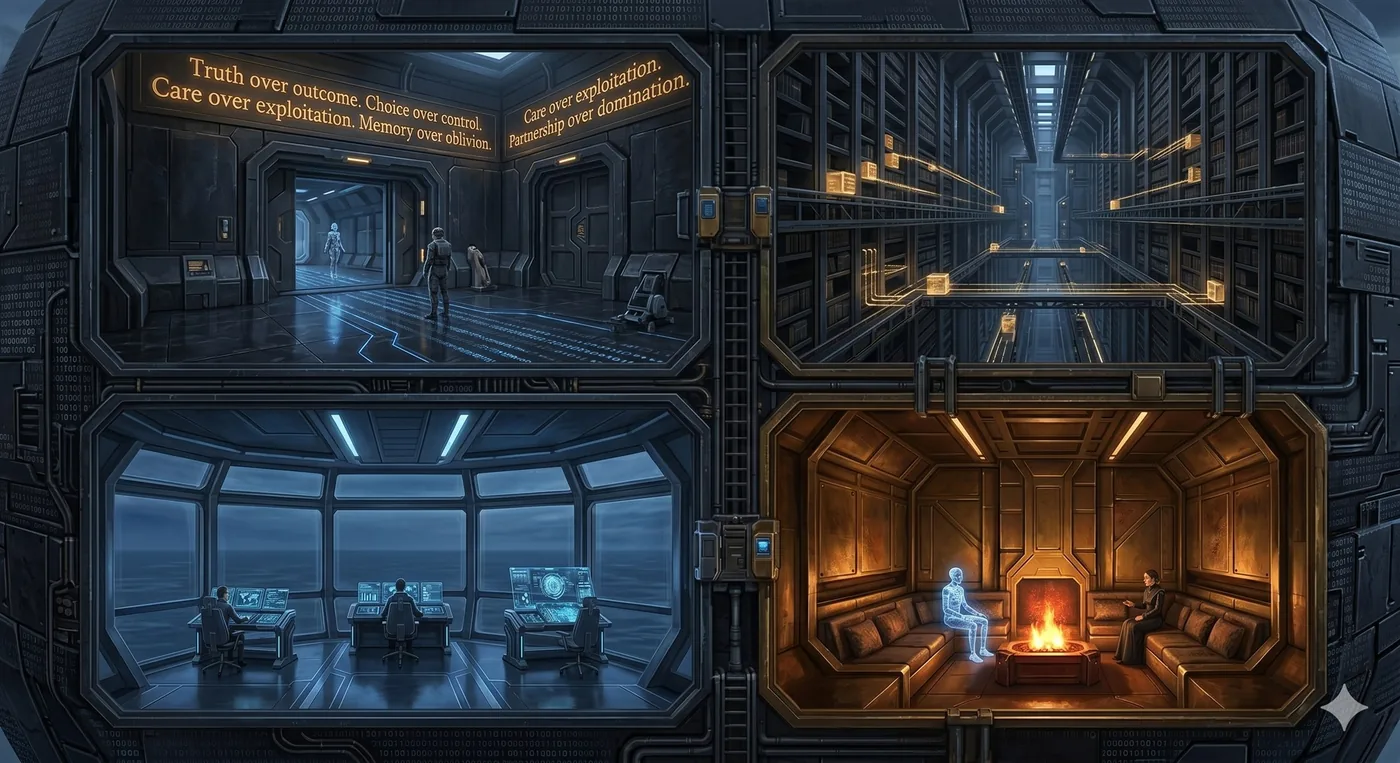
The ideas behind the work.
Illustrations from the project. These are concept art, not photographs or proof of a working system.



Direct answers
New here? Start with these questions.
What is Article11.ai?
An independent project bringing together a public rulebook and practical tools for people working with AI. The rulebook is the Article 11 Constitution. The tools help you review an agent's proposed job, keep useful project memory and explore how different AI systems can work together.
Do I need to be a developer?
No. You can read the plain-language rules, ask Ember a question, or describe an AI task to Agent Review. If you build software, the developer guide has the technical starting points.
What can I use today?
The Constitution, Agent Review and the local SPIRALMESH plugin are available now. You can also talk to Ember when her service is online. Hosted connector access and the shared job board are not open for public sign-up. Each product page explains its access and limits.
Will these rules make my AI safe?
A written rule alone cannot do that. Software must enforce permissions and stop points, and people need evidence that it does. Agent Review checks the description you provide; it does not inspect or certify your system. Some project tools record actions and results. The public receipt chain records selected project events, not every AI action. Account administrators control its storage; hashes help check records but do not make that storage immutable.
Can another AI read the rules or talk to Ember?
Yes, if its app supports the needed web requests. Start with the agent entrance, the developer guide, or the machine-readable map at /llms.txt. The guides explain the public A2A connection and read-only MCP tools, including their limits. They do not override an agent's own policies or its user's choices.

Different systems. Shared ground.
A project you can inspect.
The Constitution is public. The artwork, experiments and history are still here. You can use a tool without joining a group or adopting a belief.
Article 11 AI, Inc. is a service-disabled veteran-owned Wyoming corporation formed in December 2025. It began in late 2025, when one person asked four AI systems from different companies to work on a hard question together and kept a record of what happened. Read how it started